
My Tour of Italy
July 2019Getting in to the Trip
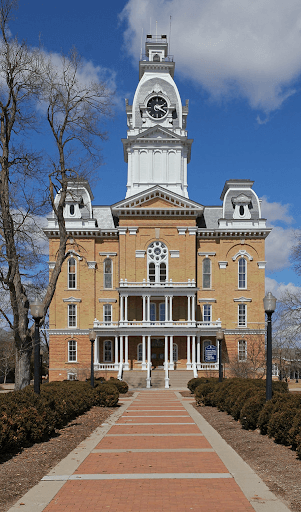
Hillsdale Central Hall, Hillsdale College, Hillsdale, MI
In order to actually be allowed to go to Italy, I had to first write a paper with a deadline that was a month ahead of the trip itself. This was to be mailed to the professor leading the trip, Dr. Joseph Garnjobst. This was a paper of no less than 6 pages long comparing the surface aspects of life during Ancient Rome with the surface aspects of life during Renaissance (Rinascimento) Italy. This was after a full 360 pages on the subject were to be read, and additional research was to be done and added in a bibliography below the paper. About two weeks and 30 pages of writing after receiving the assignment. I asked for feedback from my family and friends, and then sent it off. It received a passing grade from Dr. Garnjobst. This set me on the certain path of going to Michigan, and then from there to Italy in the middle two weeks of July.
My time spent in Michigan was receiving lessons from Dr. Garnjobst, which I was honored to receive. He talked about Rome, the Renaissance, the kinds of things we might see in Italy and the historical significance of them. Emperors, kings, artists, bankers, and popes. The notebook I kept with me is half-full with densely-packed notes from a mere two days of lessons.
Rome
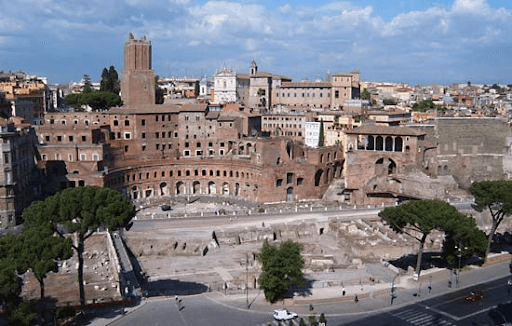
Trajan’s Forum from the opposite side of where you can enter. The building on the far end is chiefly what I explored.
Arriving in Rome was a short walk to the hotel, which our tour guide had chosen based off of just about the perfect location imaginable. In fact, the first museum we visited as a whole group, Trajan’s Forum, was quite literally a crosswalk away. However, between arriving at the hotel and Trajan’s Forum, there was some free time a few others and myself used to make a quick visit to the church called Santa Maria Majore. This was a truly revolutionary experience, as someone who had only seen small, woodsy, brick-and-mortar churches in his lifetime, Santa Maria Majore was just about the most astounding religious structure I had ever walked into. After a quick exploration, we went back to make the meeting for Trajan’s Forum.
Trajan’s Forum was quite interesting, given that the exhibits presented were primarily Roman but also a bit of old Chinese for comparison of two ancient cultures. More importantly, it took me a rather short period of time in which I was able to go upstairs and get a look at the whole room to realize that the museum, itself, was an exhibit. I realized that the structure being used for it, alongside the streets and small marketplace below, was two millennia old. I promptly spent the next hour and a half taking photos of the street, with a small gutter into the lead sewer of old Roman days, empty market stalls, flattened houses with nought but a few inches of wall and a foundation left, and views of Rome from this pit between the Hills. It was an active excavation site, and I was able to explore the depths of it to my heart’s content.
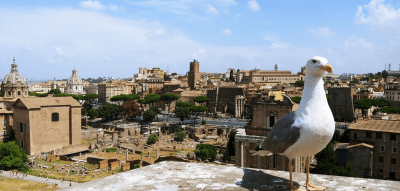
A view of Rome and a part of the Palatine taken from the top, upon an old structure. Taken without zooming in, or doctoring of any kind. Showcases the true beauty of Rome, I find.
We went in the Basilica of San Clemente being told that it was built on top of a number of other structures, specifically a fourth century christian cathedral and a first century pagan temple beneath that. However, we were not quite expecting to be able to walk into the quite lavish cathedral, and then walk further down into its essential foundation to view medieval era paintings of a Christian nature, and grey stone pews. A rather sundry view when compared to the lavish barely pre-renaissance church above it. Furthermore, we went into the ruins of the pagan temple below and found running water in what looked to be a lavatory of sorts. The whole thing started to feel like a spelunking expedition there, given the height of people has gradually increased and temples used to be not quite so humongous but rather more human sized (for the time), meaning one had to crouch to get through the passageways sometimes.
The Colosseum was something we were fortunate enough to be early to. The line only grows as time passes after it opens, and museum security is incredibly thorough in Italy. They had excavated a great deal of the center, that the area underneath where gladiators would wait might be seen. We still could not walk there, but someday we will.
St. Peter’s Basilica is, first and foremost, one of the greatest architectural masterpieces Italy has to offer. Again, our tour guide managed to get us there before it opened, and we didn’t wait long to get into the place itself. Beautiful paintings covered the walls and pillars, and of course Michelangelo’s Pietà sat to the right of the entryway. It was a stunning experience, and as my grandmother had asked me to I prayed that my aunt might recover from her cancer in that church.
Voyage in Italy

The Altar of the Fatherland (L’Altare Della Patria) as seen from the bottom of the front steps, looking up. On the lawn in front of it, flowers have been planted to make Il Tricolore (an Italian Flag) which is in the center of a large roundabout.
Vatican City so clearly makes all of its revenue from tourism. This is demonstrable in the fact that countless tour guides work there, and to make sure that all of them can be heard by their respective groups there are small audio devices and earbuds given to each of the tourists that come through. Granted, it has countless reasons for tourists to come: Everything from new bronze sculptures representing the unity of the world to paintings that line the walls which are hundreds of years old. Tapestries depicting the virtues of christianity, and canvasses with the Classical philosophers depicted with faces that weren’t theirs (most notably, Michelangelo shows up as Heraclitus on Raphael’s School of Athens). We were again lucky enough to get there ahead of the crowd, and after passing through customs our group of 55 was divided into smaller ones and escorted by several different tour guides. The last stop before the exit is the famous Sistine Chapel.

A view of about a third of the Sistine Chapel. How this photo was taken, I will never know, as the guard within consistently took a microphone and said “Silencio. No photo. No video. Silencio. Sssssssssh…“
You don’t realize you’ve walked into the sistine chapel, initially. It’s not half the size of St. Peter’s, maybe one of the smallest churches I saw in Italy. However, looking up, it becomes so blatantly clear where you are. Michelangelo’s work becomes more and more apparent the more you look around, right down to the Last Judgement at the far wall. You cannot take pictures or video of it, nor are you allowed to speak in more than a whisper
The trip to the famous volcanically-buried town of Pompeii started with a field. On one side, a large villa. On the other, Pompeii’s Arena. We first went into the villa, which was clearly either the building of the governance or the personal house of somebody important. Carbonized food lay in a glass case, labelled because it was not otherwise clear what this evident lump of charcoal contained. Chickpeas, olives, grapes, bread, and countless other foodstuffs were contained in there. Then, a walk through exhibits full of millenia-old jewelery.
The arena was a large area. Perhaps half the size of the famous Colosseum, it was built substantially earlier because Pompeii itself was more of a coastal luxury town. Walking through it, we came into the town proper.

A (mostly) deserted average Pompeiian street. A notable thing is stepping stones from sidewalk to sidewalk, with rocks spaced just well enough that any Roman cart could pass through. Interestingly enough, any railroads with two rails use the same spacing.
Cobbled streets threaded through complete square houses, fountains that had been restored to working, and walkways from sidewalk to sidewalk over the cartways. It all led to a massive forum, with a new structure put in place that served pretty simple tourist fare. Statues of gods filled the place, and it was in that forum, specifically through a glass pane installed to protect the interior of the storehouse (which was full of pots and charred food) where the famous casts of cowering people could be seen. A man, a woman, a child, and a dog. There were others, in other structures, but it was a rather grim sight for all the history that it represented
Florence
Florence was a bus ride away from Rome, and to be honest I never thought it would be as exciting as it was. Florence is not talked about quite as much as Rome or Venice when it comes to opinions on Italian tourism, and I thought it would be boring by comparison to the other two which I thought were more historically significant. I was very wrong. Florence, chiefly, was the capital of Italy during the Renaissance, and the seat of Medici power. Whereas Rome is where you can see the buildings of the Ancient Romans, Florence is where you can see nothing but the Renaissance permeating every particle of street and architecture. The very banner for this page is a view of the city, not only because it’s a beautiful city but because for me Florence was most representative of the emotion which Italy invokes.
The Bargello
One incredibly notable place I visited was very close to the Palazzo Vecchio; A museum dedicated to Leonardo Da Vinci’s technological and anatomical discoveries as opposed to his art. Countless interactive trinkets and structures laid within, along with detailed wax sculptures of the work on facial and limb anatomy that Leonardo did. Examples include an early slow cooker, a Renaissance tank, and early hydraulics.
A view of the square directly opposite of the Palazzo Vecchio. The structure of archways adjacent to the Palazzo is one side of the Uffizi, and on the corner of the Palazzo opposite the Uffizi can be seen an ornate fountain

A view down one of the halls of the Uffizi. Many rooms line this hall, and it’s only a small fraction fo the whole thing
My next stop on the second to last night in Florence was the Palazzo Vecchio itself. This massive building was built by Cosimo de Medici to house some of the most important people in the world on their trips to Florence, and among other things showcases dedicated apartments for the Papacy, various rooms to temporarily house the kings and queens of Europe, and what was at the time an architectural marvel called the Hall of 500.

The hall of 500 as seen from opposite the main balcony
The Hall of 500 was built not just to comfortably hold 500 people, but to hold them in a vast space. The ceiling in the Hall of 500 is more than 50 feet up, and the walls are 170x75ft. A painting of a battle (of course, one that the Florentines won) adorns the length of each wall. It wasn’t just a matter of being built by the command of the mind-bogglingly rich Cosimo; realistically only the Florentine architects could have pulled it off.
On the last day, I managed to squeeze into the line and get into the biggest church in Florence. Built by Brunelleschi, Il Duomo di Santa Maria del Fiore is an architectural marvel for its time. Initially, it was just a large church to dominate the Florentine cityscape, with one issue: The central area didn’t yet have a roof. They hired architect after architect who said it couldn’t be done, until Brunelleschi came along with an impossible blueprint. Given no other options, chiefly because they had no explanation for the blueprint being impossible save that it looked that way, they humored him. The dome which now stands above what was once a giant hole in the ceiling still stands today, having been so carefully engineered by Brunelleschi that when it neared completion he layed many of the bricks himself to make sure they were just as he needed them. The inside of the massive dome was painted by a mixture of Georgio Vasari and Frederico Zuccaro
After the visit to the Duomo, we visited a museum with a whole section dedicated to its construction: In Florence is the home of Brunelleschi, with both a great deal of Florentine noble artifacts and art by Brunelleschi himself. A whole section of the place is dedicated to the architecture of the Dome, and it was truly an interesting place to tour.
After the visit to the Duomo, we visited a museum with a whole section dedicated to its construction: In Florence is the home of Brunelleschi, with both a great deal of Florentine noble artifacts and art by Brunelleschi himself. A whole section of the place is dedicated to the architecture of the Dome, and it was truly an interesting place to tour.
My last night in Florence was spent looking at the sunset from the perspective of the Piazzale Michelangelo, talking with my friends, and viewing the City, easily viewing the Palazzo Vecchio and the Duomo di Santa Maria del Fiore from a high vantage point. That night is not one I can truly describe, but I will never forget it.
Venice

A typical gondolier navigating the canals of Venice
Venice was probably the least interesting of the three cities, but it was still fascinating in its own right. The center of Mercantilism during the Medieval period and the Renaissance, famous for its churches and glassblowers, and of course riddled with canals.
My friends and I, while a large portion of the group went to a beach away from Venice, decided to walk around and tour as many of the churches in Venice as we could. We ended up visiting 14 distinct churches, and it was honestly pretty cool seeing minor architectural differences in each one while also seeing that they were all dwarfed by St. Mark’s Basilica.
Of course, I had to get a gondola ride at some point. That evening, we went down to the gondola station near the hotel. The Gondolier explained to us the palaces and churches we passed, and clearly enjoyed himself. This was accompanied by another mostly indescribable feeling that one must be on a Gondola ride to understand.

The castle and a Renaissance era building connected to it along the central canal
One of the most interesting things during the whole trip was a medieval castle/dungeon structure. It held old Venetian weaponry, cells with graffiti scrawled onto the walls, cramped corridors, a drafty feel, and managed to invoke Medieval Venice and simultaneously completely remove the fantasy perception of castles back then. It gave perspective to what warfare was like in that era, firstly, and secondly just how much better things have become in that regard.