
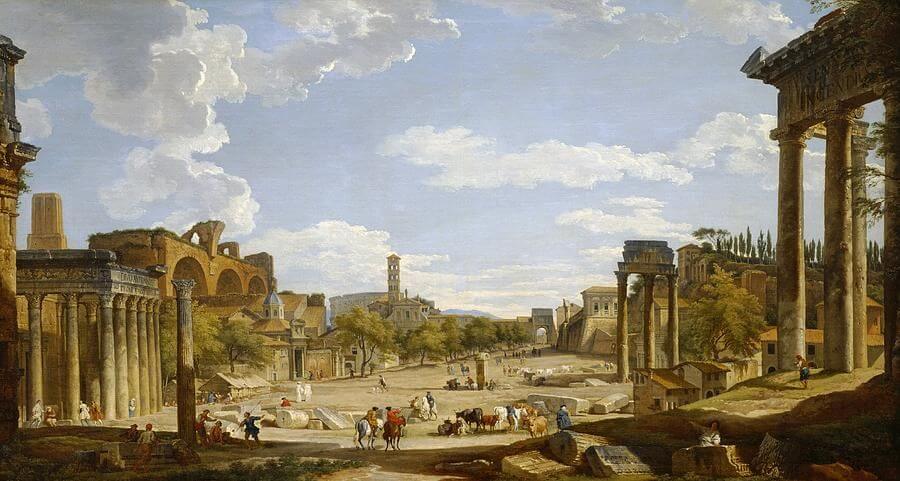
An Analysis of the Contrasts and Comparisons
Between Ancient Roman Times Some Two-Thousand Years Ago
and Italy During the Rinascimento
We are all Romans.
The Ancient Romans of some two millennia ago are indeed ancient, yet they made such an impact upon the world with myriad cultural and technological revolutions that the entirety of the western world has some aspect of the ancient Romans ingrained into their culture. The Romans acted as the people who preserved Greek history for us to read about, and they gave much of their own history to the annals of modern historical writing. Rome defined the fifteen hundred years of western history after the fall of its empire, and as a result its significance cannot be ignored. We are all Romans because their history influenced the history of every other people in the West, culturally, technologically, scientifically, philosophically, and in countless other ways.
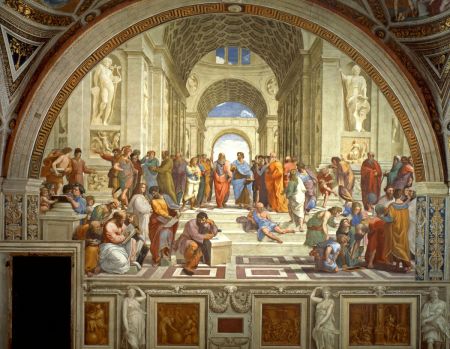 In a way, we are also all a more modern form of Italian. Of course, the people of Europe throughout every age after Rome act themselves as an extension of the Roman culture that defined ancient Italy, but during the Rinascimento (Italian Renaissance) Italy would have yet another important role in culturally revolutionizing the West. The most important pieces of art in the modern day come from the Renaissance, and music as we know it today was greatly influenced by the Renaissance musicians. We owe the Renaissance writers and their predecessors something yet more significant than the art forms that we practice today, though: Rome. The Renaissance revived an interest in the sciences, in history, in ancient Greece and Rome, and in all the classical practices that had been lost during the Middle Ages. We are all Romans because we are also all followers of the Rinascimento.
These two worlds we are about to place side by side may belong to a different time and, at least in the English speaking world, a different land far away, but both these worlds are direct antecedents of our own. We owe them many of our ways, including our language, our majority religion, and myriad everyday things that combine to make us who we are. We are, in part, who they were. That is why it’s important to study them, just as it’s important to share stories from our grandparents and parents with our children and grandchildren; we, as humans, find immense use in the lessons of the past, including those anecdotes from our ancestors. The artists who came from both cultures, the huge surges in scientific discovery that made our modern world possible, and the fact that both Rome and the Italian Renaissance not only gave us their own cultures but wrote about the cultures, people, and achievements of other cultures. The first western historians were Greek, but the historians who preserved the writings of the Greek historians were Roman, and the historians who wrote about the Roman historians were Renaissance Italian.
 Indeed, it can be found that Italy during the Rinascimento had a different culture from Italy during the time of the Romans. However, as much as these two worlds were different, it is undeniable that Renaissance Italy’s world had many tie-ins to the Roman world. If the two worlds can be seen as clotheslines, hooks can be hung from the Roman line that support the Renaissance line, but they are still separate lines (if made from the same substance). Such is the relationship between the two worlds which makes them so interesting to talk about in comparison to one another.
This point in history is immortalized for two reasons: The first is that Rome is a definite ancestor of modern Europe, and as such the West has a fascination with it that leads us to canonize certain moments in Rome’s history. The second is that it marks the day the Republic truly fell. The day the Senate admitted defeat, and the Republic officially became the Empire.
 Rome is known for two major systems of government during its peak. The first one of significance is the Republic, a system that we know well today as it has become the dominant system of the world’s most successful nations. In the case of the Republic, the citizenry of a country elects multiple officials into positions of influence within a government. During the beginnings of Rome, the people could elect only two consuls. However, the elected positions soon grew to include all public positions. Each position was elected for a total of one year, with the exception of the Censor, who was elected for a five-year term.
Elections were done with flyers advertising this or that senator, not unlike the elections of today, and all citizens of the Republic could vote in its later stages. When the citizens actually held some degree of political power, it was exclusively men of 15 or older who could vote, and were citizens.
Roman law was changed numerous times during the era of the Republic. Many of the changes gave Plebeians more power and influence in the government, with one of them mandating that one of the Consuls at any given time be a Plebeian. Some of the earliest laws passed during the period around the Twelve Tables gave the Plebeians the right to vote, whereas previously only Patricians held that right. For the most part, the law followed the same guidelines as it always has. The major differences were restrictions on who one could marry and what social status gave someone. However, many times the law was blatantly ignored by Patricians and Plebeians alike, and in the case of Plebeians if somebody was murdered there was rarely anything done about it. There was no police force to speak of, only mercenaries that the Patricians could hire if they wanted to investigate and punish somebody. As such, Patricians had a degree of legal safety but Plebeians rarely did. The streets of Rome and cities like it were consequently rife with unpunished bloodshed, open theft, successful con artists, and brute strength meaning someone had all the power. The average city dweller, likely illiterate, understands little besides the language of violence.

This average example of the cityfolk is either a slave or a poor freeman. Slaves were a common sight in the streets of Rome, with every family having at least one labor slave, and the rich families owning slaves by the dozen or, on occasion, thousands. Roughly 35% of the population in the Empire is made up of slaves, and these slaves are of varying quality. Greek tutor slaves were highly prized, considered nearly human, and owned by rich families to teach their children. The vast majority of slaves were labor slaves, who did all the menial labor and were considered so subhuman that they could be murdered with no legal punishment. The master could hire the effective patrician police force, a band of people paid to make others disappear, in order to incite a deep feeling of regret in the murderer.
A major group of people found in the big cities was the poor citizenry. These people would bounce between the equivalent of minimum wage jobs. They rarely owned any land, living in the myriad insulae (apartment complexes) that could be found scattered throughout any major city. Many of them wouldn’t eat at home, choosing instead to eat at any of the nearby soup kitchens for lack of their own home kitchen. They also could not afford to send their children to school or have them tutored. However, each of the families that lived in these insulae might have one to two Germanic or Gaulish labor slaves, especially if the head of the household had a more regular job working for an established merchant or architect.
 Most of the labor slaves went to the common merchants or artisans, who comprised the middle class. Merchants sold not only goods, but also services. A horse merchant might also occasionally make someone disappear for the right price.. These were the backbone of the Roman economy; they either made the goods that were circulated throughout the city or actively circulated said goods. They could often afford to send their children to one of the schools that could be found in each city. Frequently, they owned several labor slaves to do the menial labor. The middle class citizen typically owned their own small house, or lived in a better quality insula. They could always, at least, afford better than a soup kitchen could offer, either having a labor slave cook in their own home or having one fetch some good hot food from a local restaurant.
Of course, what food would there be were it not for the various middle class landowners? The landowners of the Roman Empire fed everyone, having labor slaves plant and harvest crops yearly. While all legionaries got land, only few got good land. Thee people who could afford good land were held in high esteem. Senators would frequently retire to their own large farms, and being a landowner of good land was a fantastic position to be in. They were well fed, had money, and had the best slaves. They also sent their children to school, or had Greek slaves who would tutor their children at home.
The successful landowners occupy an odd position, mostly being in the upper middle class but bleeding over into the higher class. Everyone with any kind of reputation was a successful landowner, because not only was that such a fantastic way to make money that even those who were already successful went into the business, but it also was something to do outside of the single year terms that senators were given. In addition, while large amounts of money meant that government positions were open, and occupying one had several benefits, being a politician was not lucrative in itself. Political office was typically something one had to purchase or demonstrate a certain level of wealth to obtain,  not to mention the costs of a political campaign. Plutarch, in his chapter on Julius Caesar, writes the following: “As Caesar’s mother accompanied him to the door in tears, he kissed her and said ‘Mother, today thou shalt see thy son either pontifex maximus or an exile.’” Such was the risk that Caesar took when becoming a politician. Failure for the ambitious meant exile, while success meant true fulfillment of one’s ambitions.
For the ambitious to achieve their goals in the political world, they first had to achieve a place in the political world. Chief among the steps to do so was campaigning to become a politician. As politicians were voted into place, long political campaigns had to be launched, and many slaves tasked with copying flyers and putting them up throughout the region which that particular individual would influence should they win the election. There was one key aspect to this: Augurs. Augurs in ancient Rome were the equivalent of the Greek Oracles in terms of rank and function, but did so in a different way. Whereas whatever the Oracles said was treated as the direct word of the Gods, the Augurs were tasked with interpreting messages the Gods would send them. Such things came in the form of sacrificing a bird, and dissecting it to see if they could find a heart within it. While a heart was always to be found, an aspiring politician might spend a hefty sum to have the Augurs say that no heart was found, and so change the course of a political campaign. This tactic only worked because ancient Rome was an incredibly superstitious place, quite beyond the Italians of the Rinascimento.
 The Romans of old would make daily sacrifices of animals, food, or other items to various house gods for fertility, fortune, and favors. Sacrifices were also made on occasion to more powerful deities for larger favors. Of course, the bigger the favor, the greater the sacrifice had to be. Full bulls could be sacrificed, and a virgin might stand under the sacrificial altar while the bull’s throat was cut to bathe herself in blood. Sacrifices could bring good luck, the perception of power, and (with the Augur’s ability to lie through their teeth without thinking about looking over their shoulder) magical abilities such as seeing into the future. The main difference between then and now is that now a significant portion of the population doesn’t believe in “psychic powers,” but in the time of the Romans everybody believed that the Augurs and fortune-tellers could truly see the future, and truly wielded power by grace of the Gods’ gifts upon their devotees.
To lay a curse on someone was a serious action, and was one thing that would terrify even the richest of Romans: A curse wherein the sacrifice made to the gods is them who would wish to curse another. Suicide was a perfectly valid form of sacrifice, and a common one in the case of dignity loss or otherwise significant loss. In the Roman mind, this was the way to lay a curse of unrivalled power upon someone who had, at least in the eyes of the beholder, severely wronged the entirety of Rome with some horrible action against a rival (usually the one delivering the curse, who is doing so as a result of said action). Such is the relationship the Romans had with magic as used to incite harm.
Religion and superstition even bled into the military, with a common sight before battles being the general, in his tent, eagerly awaiting what the fortune tellers have to say about it. An owl sighted before a battle meant bad luck, and generals would heed that kind of sign. It was more than the plebeians that believed in such things, it was nearly everybody, with the few skeptics that existed hiding their skepticism for the most part lest they be killed by a bloodthirsty mob of people, convinced that the one they’re after is a heretic. Any stroke of luck could potentially be attributed to the gods, from getting a small discount at the market to a fog rolling in, allowing one army to ambush the enemy. Similarly, bad luck could be attributed to the gods, with everything from a stubbed toe to a volcanic eruption seen as a potential indication that the gods were not happy.
Religion was a part of normal life for the Romans, and was less along the lines of what we would today call a religion and more a way of life focused around the same sort of principle as goes behind “Karma.” But instead of someone trying to do good things so that good things happen to them in kind, someone cuts the head off of an otherwise fine rooster and offers the corpse to the gods for good fortune in the coming year (and for a good rooster to be for sale in the market before the next chicken clutch comes of age).
Part of this daily aspect of their religion was the constant reminder of just who the gods were. One could see this in the form of art all around the cities. Statues were not an uncommon sight, especially around certain squares with a temple to this or that god in them, and if nothing else graffiti always made an appearance in some way or another as some sort of commentary. Pottery frequently had designs on it, much the same as the famous Greek pots through which we can tell many of their stories. Roman pots were in a different style, of higher detail and, frequently, in relief. While it is evident that the cultural significance of art was not at all to the level of the Rinascimento, for the Romans art was an aspect of daily life, at least in part because depictions of the gods were usually put above any given shrine to them, where all sacrifices would be made in dedication to that god.
However, there were more than depictions of the gods about. Reliefs of the circus have been found on clay pots, among other things. Graffiti could be a commentary on just about anything, from daily life to politics. Paintings and reliefs could depict stories, and many sculptures (such as those we find on the fountains) were simply there to make the scene prettier. It was not uncommon to either find small keepsakes or children’s toys that were made by merchants in the form of animals, mythical creatures, or just people.
Importantly as well were the lyric arts. Roman music is an interesting thing to hear, invoking folk music for the most part. Flutes were common, drums used for rhythm, the oud could sometimes be imported as an exotic instrument to be played by Persian music slaves, and the Romans would use countless instruments besides, many of which were archaic forms of modern recognizable instruments. Chanting and ululating were also common, given that music was frequently accompanied by some sort of celebration. The rich who wanted them frequently had their own music slaves, but the poorer folk had to go to bars and the like to find any music. Music was not nearly as common or as complex as it would become in the Rinascimento, but to those who had a taste for it music was available.
 Another form of art bled into the living culture of rome: Fashion. Romans would frequently don special clothing for an occasion, with the white citizen’s toga being the day’s suit-and-tie. While dyes would become more available as time went on, the Romans were able to bring a surprising variety of color to their tunics. Jewelry was common, as well, and hairstyles along with any accompanying ornamental clips made for a regular sight among parties. Of course, income designated what one could afford. The poor might wear linen, coarse wool, or plant fibers from flax or hemp. The middle class could usually make their own clothes from the sheep they herded, or the grain fibers they grew. A few, the lucrative merchants and farmers, could buy cotton from trade with the merchants of Africa. The rich, meanwhile, could afford the highest quality fabrics. The softest wool, the plant fibers that kept one the coolest, and exotic fibers such as cotton and silk were bought frequently by the rich. Those rich patricians that got to the silk merchants before other Romans could sometimes even purchase their own small culture of silkworms.

Clothing was bought for all members of the family, with variations on the standard tunic for each gender and several colors available. A family had all the same aspects they always have, with the exception that in those times it was not uncommon for an established couple to have several children, but equally frequently only two or three children would actually be present in the family. This is because 25% of children died at birth, and a further 25% died before the age of ten. This high rate of infant mortality was common around the world, but it did still make an impact. Families may also include the extended family living in the same household, and freed slaves being adopted into the family.
Time management worked in a rigid schedule. The man of the house woke up at dawn, got up, and put on his tunic. If he bathed at all, it was simply to wash his eyes, hands, and face, for the bathhouse was in the schedule. He visited the barber to make sure he was clean shaven, and set out to his work. He would work varying hours depending on the job, take a bath fairly early in the day regardless, some would rest at midday, and many times one would invite friends for dinner. Dinner was a three-hour occasion which the wife prepared at home, given that the Romans had eaten little else that day it makes some sense. It was also a social occasion, and the true end of the day for a Roman.
Dinner was mostly made from the various staples that were in circulation throughout the Empire. It includes several courses, made up of countless different foods, but some remain constant even throughout the classes: grains in some sort of porridge, bread, fruits of various kinds, vegetables, fish, chicken, rodents, nuts, olives, and insects were a common sight upon dinners no matter what the social rung of the cook was. However, not all people ate the same things. The rich had access to exotic, tastier foods. The middle class could always eat, as artisans made good money, merchants either had the money to buy it or simply ate what they weren’t planning to sell, and farmers could take some of their crop. However, the poor would frequently go hungry.
Olive oil, however, was ubiquitous. It was sent to Roman cities by amphorae (jugs) numbering in the millions. Just as our world presently runs on crude oil, the Roman economy ran on olive oil. Olive oil could be put in just about any food, used to grease pans, used to grease contraptions, and was ultimately the oil that they would use whenever we would use any kind of oil. It was also used to hold heat and heat things, such as the public baths, and while it may not have been as complex, the Romans were capable of impressive feats of engineering, and those which generated friction or used thermodynamics frequently involved olive oil.
 For such feats of engineering and construction (for instance, the public baths) the Romans needed more than olive oil. Stone quarries numbered in the tens of thousands across the empire, with the people working in them numbering in the thousands per quarry. These were able to ship thousands of tons of stone to the bigger Roman cities each month. Many stone quarries, however, did not ship raw stone, instead shipping the components for concrete in equal number. Tens of thousands more lumber mills shipped out wood of all types.
Steel production was, for the first time in history, industrialized. Steel factories, made up of huge furnace complexes, could create enough gladii (short swords), plates for armor, and javelins to supply the Roman army, which numbered in the millions at its peak. All that in addition to the steel tools used by farmers, butchers, merchants, and just about every profession in some way or another (and the unsurprising amount of weaponry purchased for the protection of important people). Furthermore, metals such as copper, tin, iron, mercury, lead, antimony, gold, and silver along with alloys such as bronze, various types of steel, and brass were made in sufficient quantities for the whole empire. At the time, no other nation had managed such a feat of mass production.
Glass was less common. It was made in quantities that left it expensive, for the rich to own, but it could be stained to add decoration to the rich homes or used to add windows for the sake of having windows. It could also be used for dishes, goblets, chalices, and the like. Glass was something that truly marked a person of high income and status.
However, even those of high income and status only served as the more successful of the group that kept Rome going: the farmers, merchants, and artisans. These were the folk that defined Rome’s economy. They created the things that circulated throughout the nation, or in the case of merchants they circulated those things. Of course, they couldn’t do it without the mixture of paid freemen and unpaid labor slaves that they employed to manage the shops and farms. Among those construction crews could contain chain gangs, exactly like those who could be found tarring roads in the 1960’s. The major difference here is that these chain gangs were enslaved prisoners of war, not simply prisoners.
The famous phrase “All roads lead to Rome” is not completely unfounded. All roads really did lead to Rome, the city, if one knew where to turn. This vast network of engineered stone roads was engineered in such a way as rain would not damage it, and frequently ran parallel to the aqueducts which flowed to every major city. Use of the arch was made to
build bridges over rivers for the roads and keep the aqueducts safe from poisoning. The whole empire could be seen as a flowing road, between water from the mountains being used to provide clean drinking water and bathing water, and people travelling along the roads to get from place to place selling their wares or moving around for other reasons.

Of course, people got sick even with the available clean drinking water and hot, sanitary baths. Sick folks, however, could be treated in clinics that dotted all major cities. These clinics even had several recognizable surgical implements that are still in use today. To be a doctor was a common and respectable trade for the educated, and essentially held the same position as being an artisan of similar fame. The medicine of the time, while it included a significant amount of what one might call “Voodoo” in comparison to the witch doctors of the Caribbean, was fairly advanced. The Romans made painkillers, performed surgery safely, and could treat various illnesses with natural antibiotics and the like.
Rome was truly a paragon of its time, at least in Europe, spearheading so many fields that their influence upon every western culture after them is completely undeniable. The Romans had such an influence that their long-time enemies, the Goths, when they invaded, would adopt their culture (among other barbarians). Roman culture was spread throughout Europe not only as they conquered most of it, but as their conquerors would later spread it. Roman engineering is the basis for much of the modern world’s. Roman architecture still inspires architects, and has inspired architecture always since. Romans started and inspired so many fields of study that without them, it is doubtful we would ever have gone into them. Most of all, Rome left a nearly unrivalled legacy in Western culture. Nearly being the operative word.
Another time in our history stands out. A time that saw the same mixture of violence and genius as Rome, and similarly shattered the established order that preceded it.
We are now in 1418, no longer in Rome – which has indeed changed substantially – but farther up north in the famous city of Florence. The aftermath of the crusades has seen Florence and the surrounding region take on tremendous influence and power in recent decades due to their geographical and economical positioning on renewed trade routes with the near and middle east. If the power of Rome under Augustus could be symbolized by a gladius and a large brass sestertius adorned with a profile of the Emperor, this epoch would be represented by a Christian cross and a golden  florin with a stylish iris on its head. The hegemony of Rome under the rule of its first citizen over a diverse group of provinces has been replaced. Now, a range of kingdoms, duchies and republics lie within the religious grip of the Catholic church under the pope and his clergy. Florence, where we are now, happens to be a republic. Not a typical form of government for the times by any stretch, and quite probably a cultural callback to a bygone era for the people of the region, the Florentine republic is nevertheless a model for the epoch. The streets of Florence are filled with colorful fashions and vibrant activity of all kinds, families of nobles and bourgeois compete for control of government, and we are never too far away from the next plague or conflict with a neighboring region.
The following scene is the fruit of utter fancy, not an evidence-based historical pronouncement; nonetheless, the big picture is represented faithfully, and it is pleasant to imagine this momentous occasion by giving it the flesh and blood of a moment in the lives of its chief protagonists, even if we know better. In the words of Giordano Bruno, “Se non è vero, è ben trovato”. (“Even if it’s not true, it’s a good story”)
The year is now 1418, in downtown Florence. It is early Autumn; the air is cool and the leaves are beginning to fall from the trees. Outside the walls of the city, the peasantry is hard at work harvesting grapes for making wine as well as other fruits of the season such as peaches, apricots and plums. To the west, on the summits of the Apennines, cow herders and shepherds are likely making plans to come down the slopes for the winter and sell their new lambs and calves on the market. We are standing on what is now called Piazza del Duomo (Square of the Dome), but could not possibly be called that at the time because, simply, there was no duomo. The cathedral of Santa Maria Del Fiore is a symbol of the renewed wealth and culture of the city. It is already beautiful and will be the biggest church in all of Europe for years to come. The fact that it doesn’t even have a roof over its transept is a constant source of embarrassment for the city and clergy of Florence alike.
Suddenly, two enormous, gleaming doors of bronze open up and a pair of post-medieval bouncers emerge carrying a short, balding man between them.

They throw him down the steps irreverently and without a word. Sore and upset, the man remains at the foot of the stairs for a few moments, regaining his composure. He is Filippo Brunelleschi, Florentine goldsmith and artist.
Passing by is a man on a donkey flanked by two other men carrying swords. At first glance a casual observer would dismiss him as one of hundreds of merchants about the city, but a closer look reveals a number of details that betray his status as a powerful man. His escorts are impeccably dressed and dignified, his mount, for being modest, is nonetheless in a perfect state of professional care, and his clothes are similarly not ostentatious but of the highest quality. He stops and dismounts, approaching Brunelleschi. “May I be of assistance, sir?” he asks. Brunelleschi gets back on his feet, protests and curtsies, then starts muttering about how he got thrown out of the building.
“Idiots,”, he says, “I was only trying to show them that it could be done, not mocking them. Priests. Such a touchy lot.” – “The council threw you out?” – “Yes. I was trying to demonstrate… you know about the Arte della Lana’s design competition for completing the cathedral dome?” – “I do,” said the man. “I know how it can be done, “ Brunelleschi continued, “but I didn’t want to tell them how. I’ve been burned once – back in ‘01 they stole my idea for the doors and gave it to that snake Ghiberti. Damned if I was going to let them do it again this time.” – “I see, “ said the man. “Maybe I can be of assistance.” The man, ever so familiar to Brunelleschi, continues as though answering the master’s silent question: “Allow me to introduce myself. I am Cosimo of the Medici, a banker, at your service. “
It is more likely that Cosimo de’ Medici and Filippo Brunelleschi met under different circumstances. However, we do know that Cosimo de’ Medici’s backing secured Brunelleschi the contract for building the great brick dome over the cathedral of Santa Maria del Fiore. This stunning artifact now rises as Florence’s most prominent landmark. More than the mere collaboration of two individuals, this legendary project symbolizes all of the renaissance: One powerful family of bankers approaching business and finances in a new way, focusing on patronage instead of a military to gain influence and control for themselves and theirs, letting generations of geniuses, artists, and architects like Brunelleschi approach their craft with, as it were, a new perspective.

This was possible because of a veritable explosion of trade across all of Europe and the Middle East. This sudden increase in circulation, especially given the dark times of the Middle Ages, was not only a godsend for science and inventiveness but made the people who knew how to exploit it so rich that for the first time a whole new business came into play, all about managing the large sums of money that now circulated throughout Europe: banks. Of course, people got rich off of owning these banks, just as much as the people using them, and so during the beginning parts of the Rinascimento (Italian Renaissance) there were an unusually large amount of rich people in comparison to the Middle Ages. This led to a wide variety of interests, such as arts and sciences, being funded by curious rich people looking to invest. The Medicis would famously fund many an artist, scientist, and mathematician (frequently only funding one person who was several), Brunelleschi and Michelangelo being just two examples out of many.
In fact, if one group of people were to symbolize the entirety of the Rinascimento, it would be the Medici family. Not only did they make their vast sums of money from banking, which was essentially the new concept which allowed the Rinascimento to happen, but the Medicis became a famous source of immense funding for artists and scientists that caught their eye. Furthermore, they wielded tremendous political power, courtesy of their full coffers, with the most notable examples being not fewer than four popes, which wielded political power during at least the first part of the Rinascimento (essentially acting as kings of the various lords, barons, and dukes that ruled over the provinces, regions, and cities of italy), and two French monarchs. While the Medicis did lose much of their power when the official line died out in the mid eighteenth century, their time as a family was truly a crucial one for the scientific, mathematical, economic, and artistic advancements in Renaissance Europe as a whole. 
The Medicis and families like them, of considerable wealth and influence, were the drivers behind another chief aspect of the Rinascimento: Renewed trade. Finally, after many years where metallurgy, building materials, and textiles were purely local businesses, they were brought back to what they were under the Romans: massive industries that shipped to everywhere that was anywhere in the known world. The prosperity of Roman industry was brought back by that surge in trade being continued by the introduction of banking. This was a huge driver for the advancements of the Rinascimento because for the first time in many centuries, a truly insignificant portion of the population was dying of hunger, disease, exposure, or some foul combination of the three. It was still a large number of people, but it was a definitive improvement on the middle ages. The reintroduction of bathing as was done in Roman times was a huge part of that. The further outbreaks of the black plague that occurred during the Renaissance would be far less serious because of that bathing and the rediscoveries made in the medical fields (along with several new discoveries).
However, while the massive independent companies were capable of even greater output than the Romans were, this does not mean by any stretch that the poor could be compared to the rich in terms of life. The poor still rarely had their own kitchens, and now while more of them were employed and quality of life was indeed up they rarely owned their own houses, let alone any sort of considerable land. General impoverishment of the working population having followed the fall of the Roman empire, those slaves who had survived neglect and lack of decent conditions had an easier time earning their freedom. The middle class were still mostly farmers, but with slavery and serfdom all but ended, they hired the free poor to do the same jobs. The rich still controlled vast areas of land, with the difference that they also began to own the international companies that we can recognize today. Farming was no longer the only way to make any money. Commercial diversification was at play in creating an extremely stable economy from a sudden boost of trade.

That incredibly stable economy meant that anyone above the lowest classes, not just the rich, suddenly had free time with which to experiment with a hobby, like stargazing or art. If one of these folk caught the eye of a family like the Medicis, they were well on their way towards no longer being confined to the annals of history.
This diversification was only increased by the discovery of America, leading to a thriving trade in coffee (which the Italians positively adored), cocoa, corn, tobacco, and new veins of gold and silver meaning there was even more money to go around. The discovery of America also led to new lands, new places for companies to set up, and, importantly for families like the Medicis, more places to set up banks.
One major contributor to the wave of learning and curiosity was the sudden introduction of printing. The Chinese printing plate had been brought to the West, and from it came the Western invention of the printing press. This mass-produced books, and finally the unavailability of books in the middle ages was reversed into having enough books of any kind for anybody who could afford them. As an added bonus, Books were made available to all income groups because having scribes copy them down, even in mass copying centers as under the Romans, was much more expensive than creating giant stamps that could copy to heart’s content without any mistakes, without worrying about handwriting, and only needing to be maintained with ink, oil, and fresh papers to stamp more words onto.
Contributing even more to the economy is the fact that now it is commonplace to work for a boss with a regular salary instead of running a private business. The modern job structure emerges from the chrysalis that was the revolution in how people worked.

Of course, it has much growing to do before becoming what it is today, but the similarities are strong enough that it is easily recognizable. Serfdom nearly disappeared in Europe, and as opposed to the independency of the Roman economy as accepting outside trade for luxury and exoticism but nothing more, the flow of merchants spread throughout several countries and each country depended upon the flow from others for various necessities. The rich families were ubiquitous, and the banks some of them controlled equally so. The economy of a country is not dependent on the other countries, but is dependent on the merchants that come from them. This characterizes the Rinascimento. Between regions, and even countries, the whole of Europe is unified not by an empire as under Rome, but instead by the economy of that empire reborn as thousands of travelling merchants and great influential families like the Medicis.
Importantly as well to this whole interaction was that the decentralization of power into several fragmented regions identifying under a common country, and in some cases a common ruler (such as a king or queen), instead of allowing feuds between all-powerful autocrats to sever all travel between two countries. The king or queen might speak for a country, and enact some degree of federal law by applying the Mandate of Heaven using the Pope’s blessing, but did not have complete control because the ones in real power were the lords, barons, and dukes that ruled over the smaller regions in each country. If these so pleased, they could easily replace the monarch with another, and even select said monarch from a member of one of the rich families instead of the monarch’s own dynasty. However, these smaller governments were only by lords, barons, and dukes in title. In fact, each of them was a regional oligarchy, and the feudalism that many lordships are associated with was dying a slow death. Many of these oligarchies are constitutional, and some are even republican in nature. Communes, of a sort, began to pop up. They were decidedly not marxist or communist, still ruled by oligarchs and still quite capitalist, but were more people-centered than other oligarchies. Might was still right, as in the streets of the Roman big cities, but might was a different kind of right, with more power but at the same time a different kind of control.

In Italian republics, the government is much the same as under the Roman Republic. There are various positions, and various benefits to occupying each position. They are of course still elected, at least in republics like Florence. The one major difference is that senators now tend to be much, much richer as a result of the economic boom. This also bleeds over into the law, where each of the different regions in Italy took their own aspects of Roman law, modified them, and made their own sets of regional laws. This is also a major difference from the Romans, for while the Romans made the basis for most of those Italian laws, they had a federal, unified law. The Italians, on the other hand, lost much of that overarching power of Federal law. Courts were also different, given that the profession of law had progressed, and different laws were in place. Adding to that, the Christians had introduced a whole new kind of crime: heresy and witchcraft. Law in general had far more to do with religion, as opposed to superstition.
Citizenship had also changed. Immigrants can become citizens in some countries, and the ancestor to the passport was created. What comprised a citizen varied by country, but in republics it remained only the citizens that could vote. Not all governments required military service any more, but some still did. Citizens of course had different rights given each country, with several even having different classes of citizens corresponding to different economic classes. Being a citizen was also different in that throughout the streets there was still much crime, but police forces had become commonplace. Of course, they could still be bribed, but it was better than no police force at all.
One strong unifier in all this apparent micro governmental chaos was the Church. While church and state had long been formally separated, at the same time the church still had a strong hold on the minds of the people, and whatever the church says can determine who gets elected. There were numerous scandals with the popes, and many monarchs got a  Mandate of Heaven for added religious power. Europe was just as religious as it was under Rome, just less superstitious and with a different religion. Nobility frequently allied itself monetarily with those catholic churches that accepted “donations” in return for blessings, just as Martin Luther fought against. Religious strife was high between all Judaeo-Christian peoples within Europe, with religious sects believing one another to be blasphemous, let alone anything from a different religion.
However, despite the immense pushback from the church, the Roman ways were still remembered, and out of them came wonderful works of art such as The Birth of Venus which had nothing to do with christianity but became famous nevertheless. Art thrived under the explosion of newly-funded artists, and science may have gotten some people into house arrest but others were able to publish their books first, and in places where religion had truly naught to do with law books were published that incited curiosity and, through the curious, science begot science where it was legal. Even some artists were put under house arrest, and the Church fought back against the depiction of women and men in painting. The sheer number and diversity of artists at the time was too much for the church to keep under control, however, and the Renaissance displays a variety of art both christian and blasphemous as a result.
Famously, many of the Renaissance artists come from Italy. Names that would go down in history such as Michelangelo, Leonardo, Brunelleschi, Bellini, Caravaggio, and so many more that to list them all would fill several rather boring pages. It is furthermore important to note that many of these artists were polymaths, with Leonardo famously being an engineer, Michelangelo a mathematician as well as a sculptor and painter (though he didn’t like painting), and Brunelleschi not only an architect but also an engineer. Art came in many forms, and the groundwork was laid for another revolution in art (which would come after the Rinascimento): The creation of what we today call classical music. The forms of art during the Rinascimento, however, were mostly visual, with only one or two composers such as Giovanni Gabrielli, and the printing press making the popularization of later musics easier. However, there were also literal arts that were popularized, such as theatre in its modern form and poems both small and epic (take Dante for example).
The visual arts of the Rinascimento were far more numerous, though. Famous paintings, from the Mona Lisa to the begrudgingly painted Ceiling of the Sistine Chapel. Michelangelo hated painting so much that he put depictions of the people who paid him to do it in horrible situations throughout the ceiling, all while mumbling to himself about when all this was over he’d go and sculpt something whether it was by god’s will or not.  People, of course, still paid Michelangelo to paint, because he was truly a gifted painter. Sculptures were based off of the old Roman ones, for the most part, with of course many christian influences. Paintings of the virgin Mary were made by the hundreds, paintings of Jesus by the thousands, and Adam and Eve was an equally common theme. At the same time, depictions of old Roman gods in sculptures and paintings were equally common, and much of the actual painting of Greek and Roman gods in the modern day dates from the Renaissance. There are dozens of fountains which were modified by Rinascimento sculptors to be more complex than the Romans had made them. Dozens more fountains were simply sculpted and connected to existing waterlines. Some artists were appreciated for their talent, others would only be appreciated later. Some were given full workshops to hole themselves up in for years at a time with servants bringing them food and water, others crammed themselves into the same old apartment buildings, creating art between their working hours, and occasionally being checked up upon by kindly landlords or neighbors.
Scientists were equally prolific, with stargazing only increasing in popularity near the end of the Rinascimento when the telescope would be invented, and such famous figures as Galileo Galilei making revolutionary discoveries. This was the most fought against aspect of the Rinascimento, as the Church did not approve of such blasphemies. However, despite the Church’s best efforts, while the Rinascimento would come to be known for artists of considerable skill it was also a time when the most important scientific discoveries of the modern world were made. Science during the Rinascimento would be the foundation for the next several centuries to come, from Phlogiston to the Periodic Table, and from the Earth rotating around the Sun to the Solar System moving along one arm in this great galaxy we call the Milky Way, only one of millions in a cluster. Such was the scale of what happened in the Rinascimento. These aspects are what truly set it apart as its own world, inspired by but separate from Rome.
 The mixture of visual arts and science was a typicality of the Rinascimento, as well. Such inventions that came from this were lacemakers when lace was first woven into existence. Fashion was only increased when alchemists discovered more kinds of dye, and how to create them. All that is simply what people did with the mixture of sciences, engineering, and art. Yet more is the architecture, designed by a group that could practically be described entirely as artistic engineers: th architects. Architecture returned to many Roman forms, but also expanded on them. Architects also frequently strayed from the Roman ways, not just expanding on them, but actually differing from them and many a style would be invented. Stained glass art, while common by then, only became more so as architects made themselves out to be one third painter, in addition to an engineering sculptor as they had been before. In Italy, especially, every major town has at least one major landmark that was built by some upstart architect during the Renaissance.
The Rinascimento was of such influence to modern Western culture of every kind that it is the only true rival to Rome in influence. While it would indeed be inspired by the same Romans, it would be inspired in such a way as to influence modern western culture utterly differently. Chemistry was mostly refined as a result of, at least, ground work laid during the Rinascimento. Astronomy, which the Greeks were the first to explore, was practically reinvented by the stargazers of the Rinascimento. Practically every field that the Rinascimento either created or expanded on had such a tremendous influence upon the Western world that neither, truly, can they be ignored in history. All this because some people got rich, and decided to give some of their tremendous sums to creative people whom they liked.
Ancient Rome and the Rinascimento, while the latter clearly took much inspiration from the former, exist as two entirely different worlds of the West. Politically, neither were very secure, but where the Rinascimento was several governments with a common cultural influence, Rome was several cultures unified by a common government. The Rinascimento families controlled everything, much like the Roman rich families (Junii, Scipii, Julii, etc.), but unlike the Roman original families the only relation to bloodline in Rinascimento power was the family passing the wealth which controlled power down, in comparison to the Roman family power which still had a significant amount to do with wealth but also had to do with family honor and the bloodline itself. The Junii were rich as well as being one of the founding families of Rome, and that made them heavily involved in politics. Part of their involvement was religious, as the gods were believed to smile upon them, and a few of the chief augurs were Junii because of that. The Medicis, on the other hand, were rich, and that was it. Nobody cared about the Medicis before they became bankers, and when they became rich off of banking they were the proverbial “talk of the town” in Europe. There was nothing else to them besides wealth, nothing that gave them the merit to be French monarchs, nothing that made them particularly holy enough to be Popes.
The two worlds shared having quite a bit of free time for citizens, time enough to explore sciences, engineering, and art.  However, to go anywhere with those things during the Rinascimento meant a rich family had to act as a sponsor, and in order for that to happen the citizen had to truly be a prodigy. Meanwhile, in Rome, a career in art simply didn’t exist unless as a dancer or musician, and art was mostly used to enhance free time. Rinascimento Italy partially took its deep appreciation for art from the Romans, who would brightly paint their houses, sometimes even elaborately painting them. Yet, Rinascimento Italy had a considerably higher number of actual professional painters and sculptors as opposed to people who would do it on occasion for a price, but worked a different job overall. In Rome, there were careers in sculpting, and some people professionally painted houses, but practically no one ever sold paintings or sculptures professionally.
 Another big difference, however, was the news. The printing press meant that newspapers could be published and handed out, while in Rome no such insignificancy was copied by the important copiers, but instead a town crier held the daily copy of the news and spoke it aloud throughout the day. The news would also contain different things, given that the town crier would have to read through events himself, and so more concise stories were given. The newspapers, meanwhile, could be read by anyone who could read at their leisure, and could be mass produced, so the idea of the news story was popularized.
In both Rome and the Rinascimento, the architects were a highly prized group, famous for creating every major landmark (but perhaps not decorating it). In Rome, however, it was a profession that someone could just about go anywhere with. Being a renaissance architect meant working for the state or the clergy. The buildings that Roman architects built drove the expansion of Rome itself. Those built by Renaissance architects focused more on glorifying and enhancing the reputation of what was already there. The two were crucial for progress, but Roman construction was more functional and Renaissance construction more status driven.
The religion of the times was regarded quite differently. In the Republic and Augustan Rome, religion also meant superstition. In the Christian world, one could not curse another, while in the Roman world curses were taken extremely seriously. While it’s true that the Christian world believed in demons, they were seen as the cause of bad luck and ailments of all sorts, and as common as those were, they were not as common among one person or one family, instead simply ever present in the population. The Romans thought that without sufficient appeasement, the gods could intervene in life at any given moment. The Christians also all prayed to Jesus, or the Christian God, while the Romans prayed to a vast array of gods including local house gods. It can be summed up as the overarching view of a religion in Christianity, or the casual advice and caution in the day-to-day aspect of superstition in Roman Paganism.
The two worlds in general were simply vastly different, and closely tied together. To use the analogy from the beginning, the two clotheslines are of the same material, and the line representing the Rinascimento hangs from the line representing Rome, but the two are still separate lines. The people are different, the actions even more so, but the significance the same, and while it’s true that a line can frequently be drawn from a Roman personality or action to one in the Rinascimento, that does not mean that the Rinascimento is simply an extension of the Roman world. It is not incorrect to see the Rinascimento as rather an interpretation of the Roman world, but it is also not correct. The Rinascimento delivers much of its own package, along with its own reinterpretation of the roman world like a scarf made of two yarns woven together. That is why they may be seen as two connected worlds, rather than one continuous one. That is why the Rinascimento is not the clothes hanging off of the clothesline, but indeed a second clothesline, being supported by the first. That is why both have their place in Western history, and it can be said that not only did Rome greatly influence the Western world, but the Rinascimento did so equally. Most importantly, the Rinascimento influenced the world independently of Ancient Rome, while remaining, very importantly, closely tied to it.